
In brief
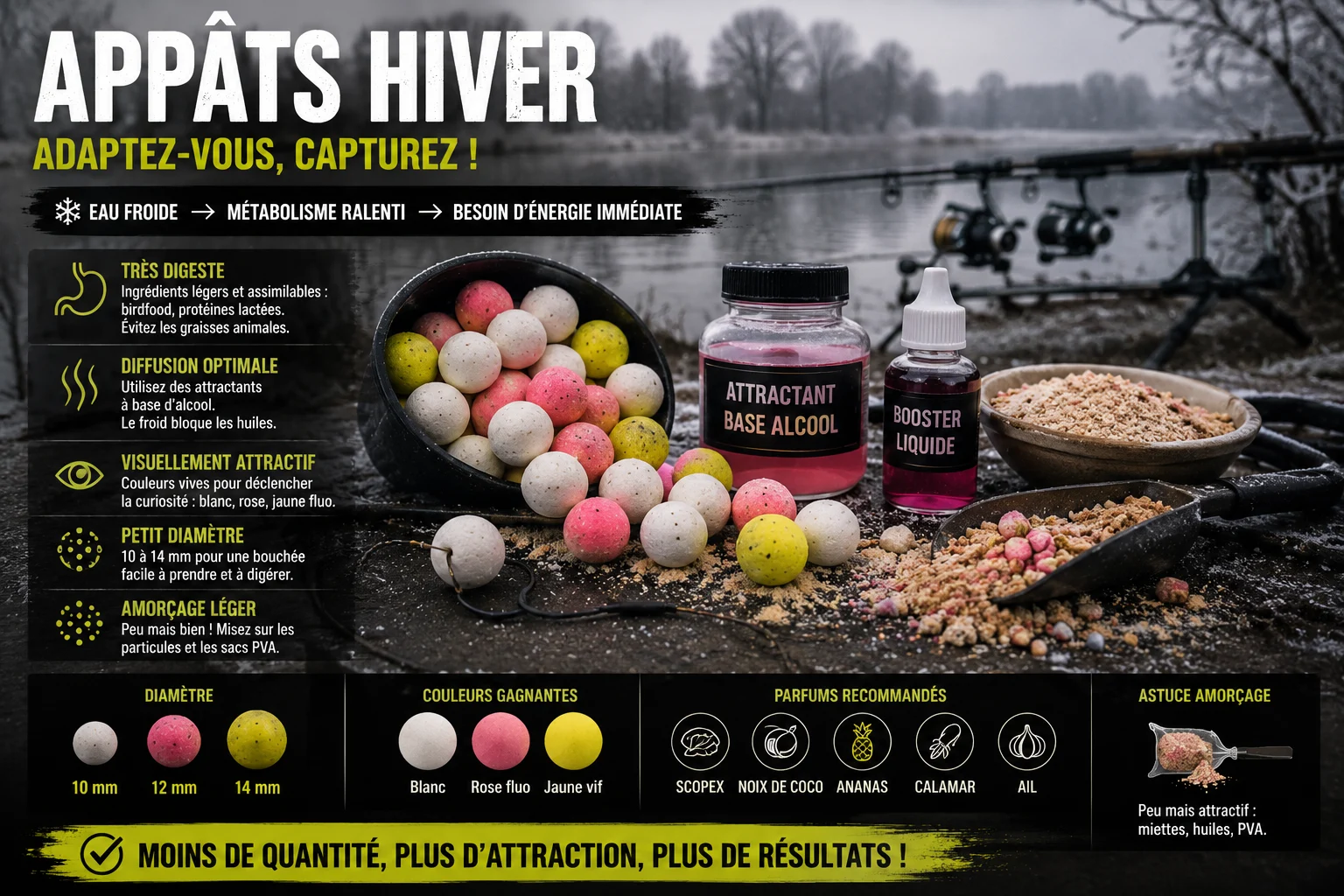
- The metabolism of carp slows down drastically below 8°C, reducing its nutritional needs.
- Focus on highly digestible ingredients (birdfood, milk proteins) and absolutely avoid fatty fish meals.
- The diffusion of aromas is blocked by the cold: use exclusively attractants formulated on an alcohol base.
- Invest in very bright colours (white, pink, fluorescent yellow) to trigger a visual curiosity reflex.
- Reduce the size of your bait (10 to 14 mm) and practise ultra-light baiting so as not to overfeed the fish.
Catching carp when temperatures drop is a real challenge for most anglers. The water becomes icy, the fish seem to have disappeared, and bites are extremely rare.
However, this is not an inevitability. By precisely adjusting your approach and the composition of your baits, it is entirely possible to have memorable sessions, even in the snow.
In this comprehensive guide, you will discover exactly how to choose the best ingredients, flavours, and colours to successfully tackle cold waters. You will also learn about the fatal mistakes to avoid during your winter baiting.
Here’s what you need to know:
Understanding fish behaviour in cold water
To choose the right bait, you first need to understand your target.
The carp is a cold-blooded animal. This means that its body temperature adapts to that of its environment. When the water drops below 8°C, the fish enters a lethargic state to conserve energy.
Its metabolism slows down, and above all, its digestive system becomes less efficient. Carp move much less and their feeding periods become extremely short and localized.
They no longer seek to stuff themselves to build reserves as they would in autumn. They look for a small bite, easy to digest, capable of providing immediate energy. If you offer them a heavy, indigestible meal, they will simply ignore it.
The two pillars of a good winter recipe
Before even discussing flavour, for a boilie to be effective in winter, it must meet two fundamental mechanical requirements: digestibility and solubility.
1. Impeccable digestibility
This is the golden rule. A bait that is hard to digest will remain stuck in the fish’s intestines for several days, negating any chance of it feeding again anytime soon.
It is essential to ban fish oils and very fatty fish meals (like the famous halibut pellet). Why? Because in cold water, fats solidify. They turn your bait into a compact block, totally indigestible, which will not attract any carp.
2. Optimal aroma diffusion
But here’s the real problem:
Cold blocks the diffusion of liquids. A salmon oil that creates a fantastic attractive cloud in summer will remain solidified in the heart of your bait in winter.
The solution? Use attractants formulated on an alcohol base (such as ethanol) or glycerol. Alcohol does not freeze. Even in water at 4°C, it disperses instantly throughout all layers of water, sending a powerful scent signal to nearby fish.
What ingredients should you favour in your mix?
If you are used to creating your own recipes and preparing your pastes with our electric boilie machine, you have the advantage of being able to control every ingredient. In winter, your mix should be airy and low in fats.
- Birdfood: It is the flagship ingredient of winter. Its granular and crunchy texture allows water to penetrate quickly to the core of the bait. This promotes rapid release of attractants while facilitating the fish’s intestinal transit.
- Dairy proteins: Casein or powdered milk are extremely soluble ingredients. They offer an exceptional amino acid profile and are very easily digested in cold water.
- Spices: Ingredients like Robin Red, garlic powder, cinnamon, or chili are formidable appetite stimulators. Spices warm up the metabolism and have an excellent natural diffusion capacity, even at polar temperatures.
Colours and flavours: how to trigger curiosity?
In summer, fish primarily find food through smell. In winter, the water is generally much clearer, visual stimulation becomes crucial.
As carp move little, it is necessary to capture their attention from afar with strong contrasts.
The table of the best winter combinations
| Colour type | Recommended flavours | Ideal situations |
| Pure white | Scopex, Coconut, Vanilla | Very clear waters, strong contrast over dark bottoms. |
| Fluorescent pink | Strawberry, Tutti Frutti, Squid | Quick fishing, lethargic fish requiring an aggressive stimulus. |
| Bright yellow | Pineapple, Sweetcorn, Banana | Fishing at the edge, dead weeds, slightly stained waters. |
Now:
A white pineapple-scented bait ball on an alcohol base is considered by many specialists to be the best bait to save a session in mid-January. The fruit’s acidity combined with the visibility of the white is a killer combination.
Size matters: reduce your diameters
The most common mistake is continuing to fish with baits of 20 mm or 24 mm in mid-winter.
Since carp eat smaller portions, you must adjust your traps. The goal is to offer a small treat that will be sucked in effortlessly and unsuspectingly.
Switch to diameters of 10 mm, 12 mm or 14 mm.
These small bites are extremely effective. If you are facing heavy fishing pressure, using a small balanced bait (wafter) of 12 mm slightly hovering above the bottom will often be the key to fooling a wary and inactive fish.
Winter feeding: the rule of ‘less is more’
Finding the right bait is pointless if your feeding strategy is poor.
In winter, attraction must always take precedence over nutrition. Never attempt to feed the fish. If you throw a kilo of bait at your spot, the carp will nibble on a few baits around your rig and then leave without ever touching your hook.
Use a surgical approach:
Crush a few bait balls to create fine crumbs. Use small soluble (PVA) bags containing a tablespoon of this crushed mix, accompanied by a bit of attractive liquid suited for cold water. This small, smelly pile around your rig is quite sufficient to attract a passing fish.
Finally, the quality of what you throw into the water is crucial. A bait ball that has absorbed moisture or has been left open in an old bag will lose all its effectiveness. It is therefore essential to know How to store boilies? in order to maintain the freshness and olfactory potency of your products from one season to the next.
Key takeaways
Success in winter is not down to luck, but precision.
By selecting highly digestible baits, visually aggressive, small-size baits formulated with liquids that can diffuse in cold water, you increase your chances. Don’t be discouraged if bites are rare. A single nice catch in freezing temperatures often outweighs all the miraculous catches of summer.