
In Brief
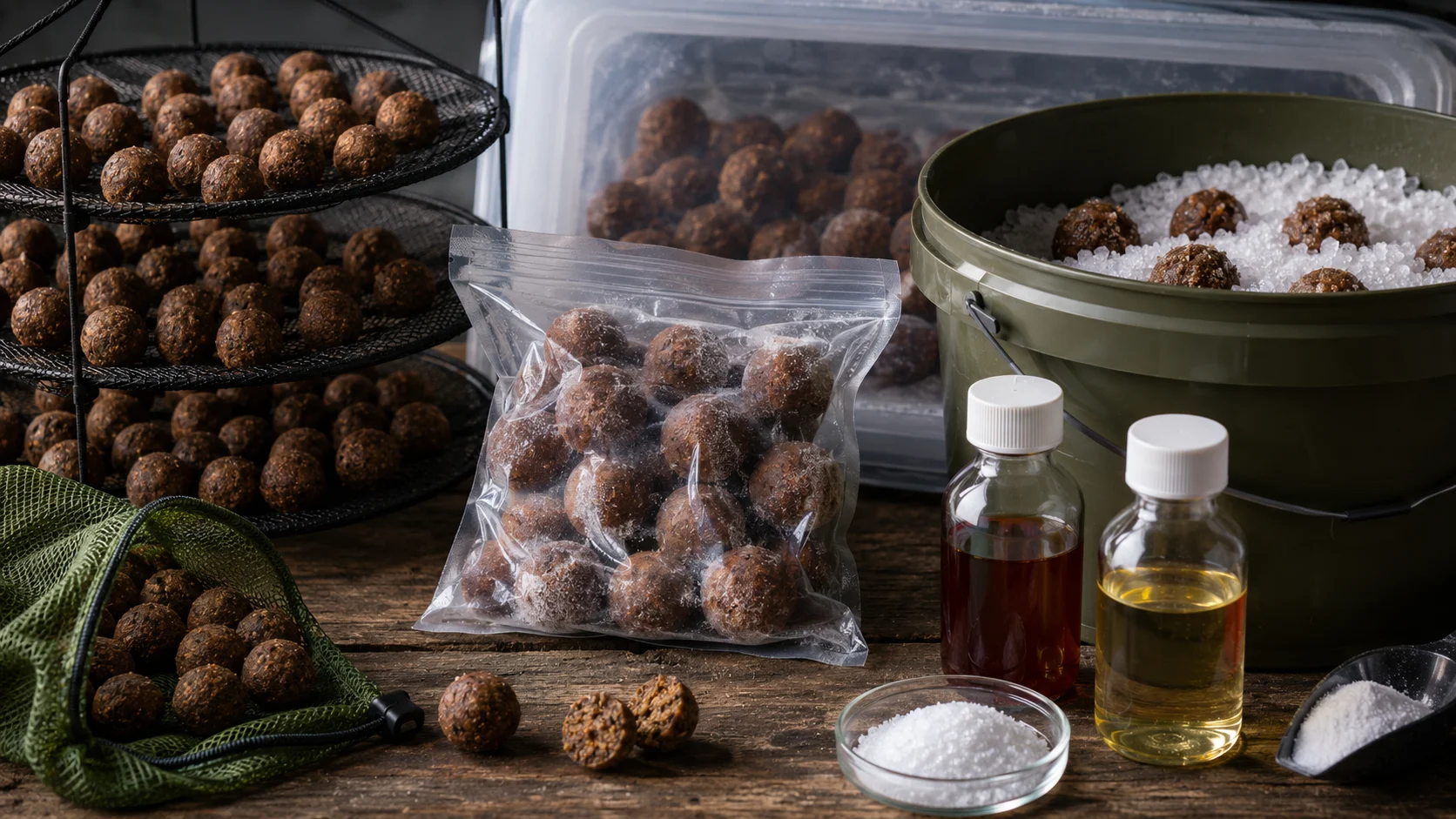
- Sieve Drying is an essential step to harden the bait and prevent short-term mould.
- Freezing is the most reliable method to store your fresh boilies for nearly a year.
- Coarse Salt acts as a powerful natural dehydrator, perfect for preserving for several months.
- Chemical Preservatives turn your homemade recipes into shelf-life baits.
The Importance of Proper Management of Your Baits
Making your own boilies takes time, precision, and quality ingredients. If we dive into thehistory of the boilie, we quickly understand that humidity is the worst enemy of the angler.
. As soon as they come out of the boiling water or steam cooker, the balls are soaked with water. Poor ventilation after cooking will inevitably lead to the proliferation of fungi and bacteria. To make the most of your time and not ruin your future carp fishing sessions, it is essential to master the storage process. The lifespan of your baits will depend on their composition (meat meals are much more fragile than plant meals) and the preservation method you choose.
The best natural methods for preserving boilies
Here’s the problem:
You’ve produced several kilos of bait but you don’t plan to use it all this weekend. How do you keep it intact naturally?
Air drying
is the basic method. After cooking, you must place your balls on a mesh sieve or in a drying net. There should be space between each ball to allow air to circulate freely at 360 degrees.
Place your sieve in a dry, cool, well-ventilated area, and especially away from direct sunlight, which can destroy the vitamins. Drying for 48 hours to a week will result in very hard baits that will keep between 2 and 4 weeks in a breathable net. Be careful, never seal them in an airtight bucket if they are not completely dry throughout, or you risk seeing them mould in 24 hours.
Freezing for long-term storage
If you produce large volumes using a boilie machine, a freezer becomes essential. It is the ultimate solution to completely stop the degradation process without altering nutritional value.
It is recommended to dry the baits 24 hours before freezing them. If you place them in the cold while they are still wet, the water will create large ice crystals that will cause the boilie to burst when thawing. Store them in airtight or vacuum bags in small portions for fishing. This way, you can keep them for up to 12 months. Remember to take them out the day before your session to let them thaw slowly at room temperature.
The salt preservation technique
What to do if you run out of space in your freezer?
Use coarse salt. It is a formidable natural preservative and dehydrator that works by osmosis.
Take a clean plastic bucket. Place a layer of coarse salt at the bottom, then add a layer of baits. Ensure that the boilies do not touch each other, then cover them with salt. Repeat the process until full and finish with a generous layer of salt before closing the lid. This economical trick allows you to preserve your production for several months. Additionally, the salt can be reused, which is perfect for those who regularly shape their boilies with a boilie roller at home.
Should chemical or liquid preservatives be used?
You may be wondering:
How do large brands sell baits that last for months on the shelf? The answer lies in preservatives.
Adding a preservative will stabilise moisture and prevent mould. It’s the ideal option if you are heading for a very long session or refuse to use a freezer.
- Commercial liquid preservatives: They are incorporated directly into your beaten eggs before mixing in the flours. Typically plan for between 60 and 120 ml per kilo of mix. They provide protection for several months in an airtight container.
- Sorbic acid (or potassium sorbate): Widely used in the human food industry, it is a powerful antifungal. A tiny dosage of 2 to 3 grams per kilo is sufficient to protect your baits without altering the taste of your recipe.
- Glycerine: It is a very popular stabiliser that has the advantage of adding a slightly sweet taste, enhancing the attractiveness of the bait while extending its lifespan by several weeks.
Summary table of shelf lives
| Chosen method | Estimated duration | The golden rule for success |
| Air drying | 2 to 4 weeks | Ventilate in a dark, dry place |
| Freezer storage | 6 to 12 months | Dry 24h beforehand to avoid frost |
| Storage in coarse salt | Several months | Isolate each layer with salt |
| Chemical preservative | 6 months and more | Observe the dosage when mixing |