
In brief:
- The hair rig is the best method for presenting this bait without hindering the carp’s hook set.
- The baiting needle is an essential tool for piercing the bait and threading the line cleanly.
- It is entirely possible to attach your bait without a needle, notably with a bait band or dental floss.
- The length of the hair and the bait stop are crucial for ensuring the proper mechanics of your line.
- Testing your rig by the water avoids failures and ensures a natural presentation.
The art of carp fishing largely relies on discretion and line mechanics. You have prepared your session, selected your best baits or used a boilie grinder for your baiting, and it’s now time to tighten your lines. The crucial step is here: attaching the bait. A poorly executed rig means certain missed takes.
Whether you are by the water with all your gear or have forgotten your accessory kit, knowing how to present your bait correctly is vital. Let’s explore together the foolproof methods for optimally attaching your boilies, whether you have a needle or not.
In video: How to Put a Boilie on a Hook?
The Hair Rig: The Basis of Carp Fishing
Before seeing how to pierce the bait, it’s important to understand why we don’t hook it directly like one would with a worm.
Why separate the bait from the hook?
This is a true revolution in the world of fishing. The carp feeds by sucking up from the bottom. If the bait is directly hooked, the fish will feel the metal immediately and spit it out before you’ve even seen a bite.
By using a hair rig, we separate the boilie from the bend of the hook by a small line (the famous “hair”). The carp sucks in the bait confidently. When it feels the trap and tries to spit it out, the mechanics kick in: the hook, free to move, tilts and pricks the fish’s bottom lip. This is self-hooking.
The Importance of Hair Length
For this mechanics to work, the distance between the bend of the hook and your bait must be perfect. Generally, we leave between 1 and 2 centimetres of space. If the hair is too short, the bait covers the point and prevents hooking. If it is too long, the carp can spit the boilie without ever getting the hook. Don’t hesitate to adjust this length depending on the size of your bait.
How to Put a Boilie with a Needle?
This is the classic method that every carp angler must master. It requires little equipment but demands some precision.
The Required Equipment
- Your rig with a hair rig (made with a knotless knot).
- A baiting needle (hook needle or fine needle).
- A bait stop (boilie stop).
- Your boilies (if you’re making them yourself, don’t hesitate to discover our boilie machines).
The 4 steps for perfect baiting
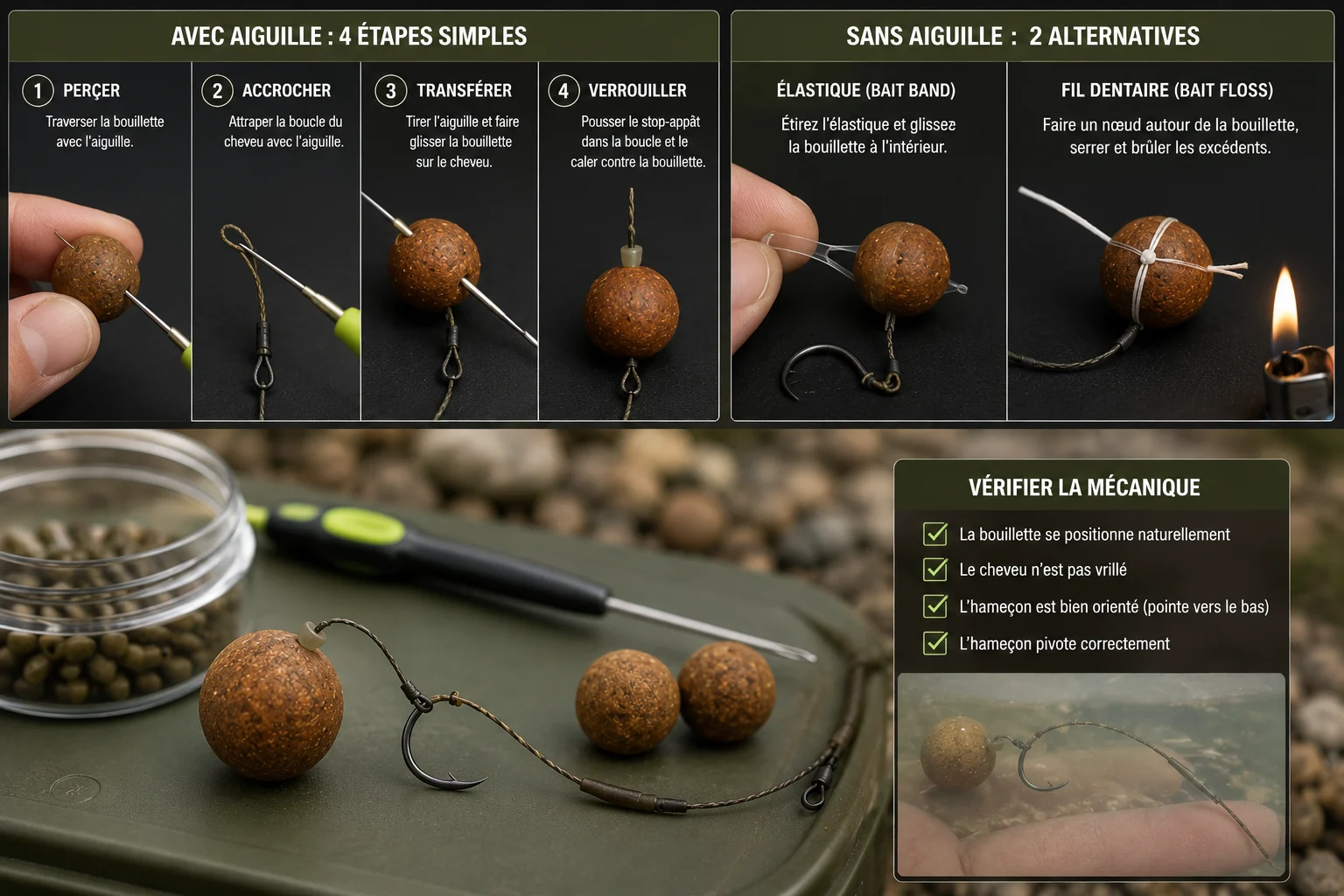
- Drilling: Take your needle and poke the boilie in its centre. Gently pierce it all the way through. If the bait is very hard, you can use a fine drill bit beforehand to avoid splitting it. Note that if you want to know how to dry your boilies very hard, using a drill becomes essential.
- Hooking: Once the needle is through, grab the small terminal loop of your hair with the hook of the needle.
- Transferring: Gently pull the needle towards you to slide the boilie from the metal shaft onto the hair. Push the bait until the loop of the hair comes out the other side.
- Locking: Insert your bait stop into the loop that is sticking out. Gently pull the boilie down to firmly lock the stop against it. All done!
How to attach a boilie without a needle?
It’s every fisherman’s nightmare: arriving at the spot, searching through the tackle box, and realising you’ve lost or broken your last needle. Don’t panic, there are very effective alternative solutions.
The elastic trick (Bait Band)
Bait elastics, originally used for feeder fishing or bait pellets, are excellent alternatives.
If your hair rig is equipped with a small elastic or a metal ring with elastic (D-Rig):
- Stretch the elastic using your fingers or a specific tool.
- Simply slide your boilie inside.
- Release it: the elastic will retract and grip the bait tightly.
This method is perfect for round or cylindrical baits (dumbbells) and avoids piercing them, which helps keep them watertight for longer.
The use of dental floss (Bait Floss)
Dental floss isn’t just for your teeth! It’s a formidable technique, often used for floating baits (pop-ups) on technical rigs like the Chod Rig.
- Thread the floss: Slide a piece of dental floss (or special bait thread) through the loop of your rig.
- Tighten: Place your boilie against the ring and tie a simple knot around the bait with the floss. Pull tight to embed the thread slightly into the surface of the bait.
- Burn the excess: Cut the excess ends, then use a lighter to gently burn the tips. Press them with the base of the lighter to create a small melted “nail head” that will prevent the knot from slipping.
Check your line’s mechanics
Attaching your bait is just the first step. Before casting your rig to the bottom of the water, it is imperative to test its presentation.
Take a small container of water (a bucket works perfectly) or use the margin in front of you. Submerge your complete rig:
- Does the boilie position itself naturally?
- Is the hair not twisted or too stiff?
- Is the hook correctly oriented (point down)?
When placed in your hand underwater, the hook should aggressively pivot downwards when you gently pull on the line. If it doesn’t, review the angle of your shrink tubing or the length of your hair. A good presentation is the key to success!