
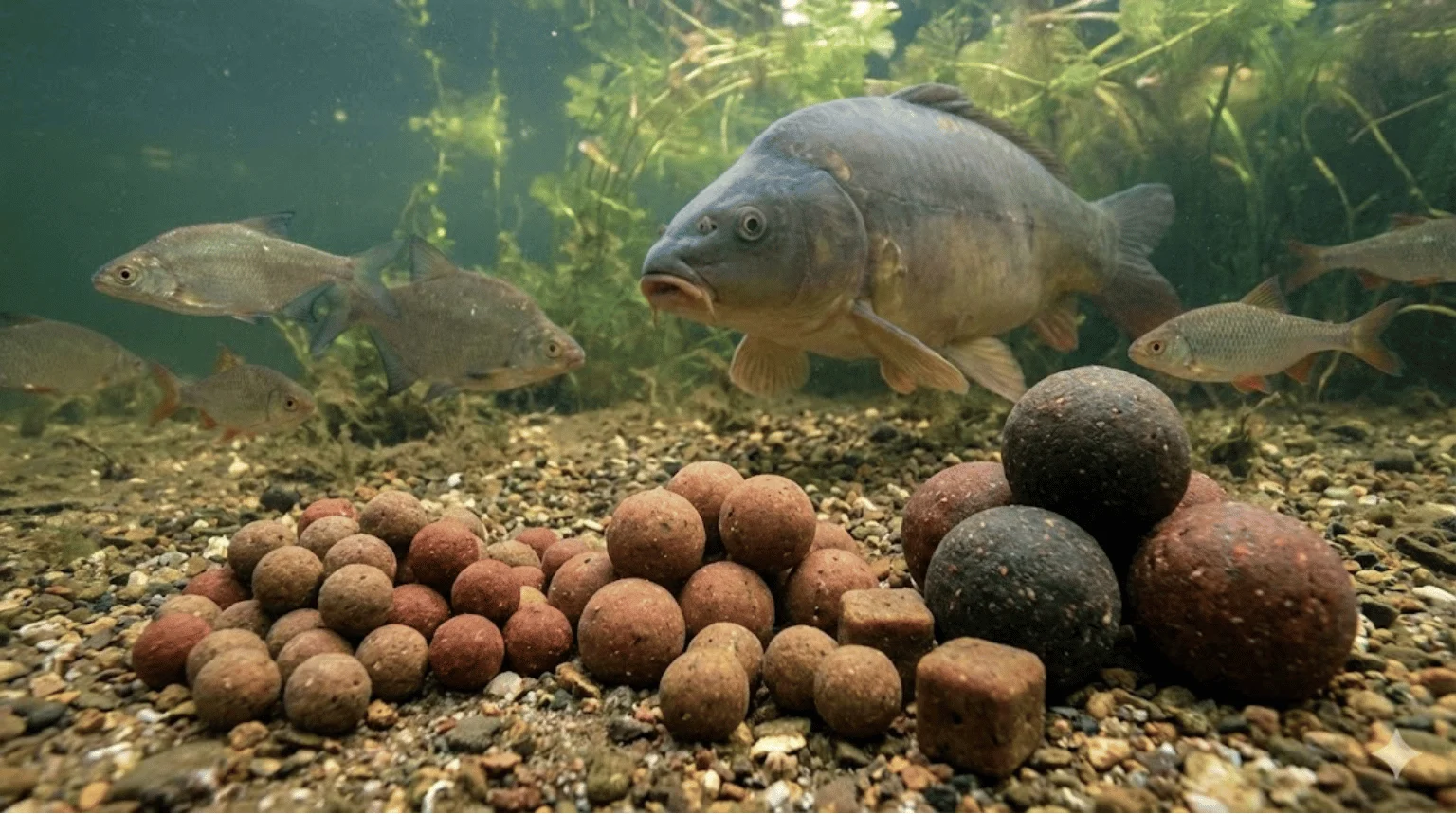
In brief: What size of boilie to use for carp?
- 10-14 mm : Ideal for winter, wary carp, and to mimic natural food.
- 15-20 mm : The versatile standard for all situations.
- 24 mm and above : Perfect for targeting large fish and avoiding pests.
- Tip : Varying shapes (cubes, dumbbells) catches educated fish.
The choice of diameter is strategic. Did you know that a boilie of 30 mm contains 8 times more matter and releases far more attractants than a ball of 15 mm ?.
Here’s how to choose the right size for your fishing.
When to choose small boilies (10-15 mm)?
Small diameters are formidable tools when fishing is difficult or technical.
- Winter and cold water : The carp’s metabolism slows down. A small bait is easier to suck in and digest than a large bait.
- Educated fish : In heavily pressured waters, carp are wary of standard 20 mm. A 12 mm bait often goes unnoticed.
- Mimicry : Natural food (larvae, snails) is often tiny.
If you roll your own baits, using a high-performance bait machine is recommended to produce these small diameters with precision and speed.
When to favour large boilies (20 mm and above)?
Sometimes you have to “think big” to succeed, especially in large spaces.
- Specimen selection : Statistics show that large boilies (24-30 mm) often capture an average of heavier weights.
- Avoid pests : Bream, tench, and catfish struggle to attack large, hard and bulky diameters.
- Long-distance fishing : A heavy and dense boilie (24 mm) can be cast much further and more accurately with a catapult than a lightweight boilie.
The trick of alternative shapes
Don’t stick to round shapes. Carp learn by association.
The cubes provide a larger volume at the same diameter and better stability on the bottom, ideal in rivers. Varying shapes (dumbbells, pillows) can often outsmart the mistrust of fish that are used to perfectly round boilies.
The physics of attraction according to size
The ability of a boilie to attract carp is based on measurable physical principles.
Volume and amount of attractants
The volume of a boilie determines the quantity of ingredients and attractants it contains. A 30 mm boilie has a volume of 14 137 mm³, which is 8 times more a boilie of 15 mm (1 767 mm³). In other words, you would need to place eight boilies of 15 mm to generate the same amount of nutrients as a single boilie of 30 mm.
Diffusion Surface
The surface in contact with water plays a fundamental role in the diffusion of attractants. A boilie of 30 mm offers 2 827 mm² of surface area compared to only 707 mm² for one of 15 mm. This difference means that a boilie of 30 mm diffuses about 4 times more easily the attractants and for a much longer period.
| Diameter (mm) | Volume (mm³) | Surface (mm²) |
|---|---|---|
| 12 | 905 | 452 |
| 14 | 1 437 | 616 |
| 15 | 1 767 | 707 |
| 16 | 2 145 | 804 |
| 18 | 3 054 | 1 018 |
| 20 | 4 189 | 1 257 |
| 22 | 5 575 | 1 521 |
| 24 | 7 238 | 1 810 |
| 28 | 11 494 | 2 463 |
| 30 | 14 137 | 2 827 |
| 32 | 17 157 | 3 217 |
Strategies According to Fishing Pressure
The density of anglers on a body of water dictates the choice of optimal diameter.
Overfished Bodies of Water
In heavily frequented waters, two opposing approaches can work. The use of mini boilies of 10 or 12 mm represents an excellent strategy to outsmart the carps’ wariness. Paradoxically, opting for jumbo boilies of more than 28 mm can also make a difference by offering something radically different from the usual range.
Low-fished waters
In low-pressure water bodies, the standard diameters from 18 to 22 mm remain the most effective. These versatile formats maximise results without requiring a specific strategy.